I Hate Corporations
· This piece is also available in Polish
Something got to me today: a situation with Medicover, one of the larger private healthcare providers in Poland.
In a nutshell: a doctor made a mistake, and fixing it — even though it would cost the company only about $10 and take 30 minutes — has now dragged on for 4 days, has burned through a few hours of employees’ work, eats up my time (and nerves) and my wife’s, and endangers the health of yet another patient.
In a word: nothing special, just another day, corpo-style.
Still, I have to be honest with you about something: in principle, I firmly believe that large organizations are a kind of “higher” stage in the development of our species. Really.
I Believe in Corporations (as a Concept)
Jonathan Haidt wrote about this once in his book The Righteous Mind, drawing on the theory of the biologists John Maynard Smith and Eörs Szathmáry about the so-called major transitions in evolution.
Haidt postulates that in the history of life on Earth, the great breakthroughs came when individuals began to cooperate closely and form a higher-order unit — a superorganism.
He illustrates it with the transition from single insects to swarms of bees or ants; he adds that humans have done this before on smaller scales, organizing first into tribes, then into city-states, and in modern times — into corporations. He claims that once the rules of operation of such organizations were defined (including a clear division of roles), corporations started to function like integrated superorganisms that adapt to external conditions, and which, for that matter — much like biological processes — grow through market selection, dominate and push out smaller units.
There are a few problems with Haidt’s argument: it seems hard to square with the fact that when we join a large organization (as employees) we don’t surrender our individuality: corporations, then, are not new “organisms” but rather mutually beneficial relationships of a contractual nature.
I’d even venture to say that the motivation of individuals in any organization is almost always self-interest.
The second serious challenge to the argument of the author of The Righteous Mind is the claim that corporations came about because they “solved” the problem of cheaters and free ridersThe free-rider problem is a phenomenon in which someone benefits from a shared good or the effort of the whole group, but bears no costs themselves and does none of the work. Example: a group project at school or university. Four people work on writing a paper, and the fifth does nothing. In the end all five get the same grade; that fifth person is exactly the “free rider.” .
I don’t know about you, but I’ve worked in a corporation and I kind of want to laugh at this: anyone who has been employed in such a company for even a moment knows perfectly well that it isn’t true! Again: acting on self-interest (often seen shortsightedly) is rampant, and what is dodging responsibility and aiming for the least possible effort to collect as much as possible if not free riding?
And here my ambivalence toward corporations shows in full: on one hand I tip my hat to their power compared with other kinds of cooperation, and on the other — seeing the sea of wrongs they commit — I honestly hate them!
A Sea of Wrongs
Arconic: Grenfell Tower

The Grenfell Tower fire, June 14, 2017
In 2017 a fire broke out in a 24-story tower block in London: 72 people died (including 18 children). Not long before the fire, the building had been refurbished, with new cladding and insulation installed.
At the time of the fire, Arconic (one of 3 companies responsible for refurbishing the building’s cladding) had for 12 years held test results showing that the panels they had installed were exceptionally dangerous in contact with fire — and still they fudged it, to hit their sales targets and avoid excessive costs. The public inquiry found that Arconic knowingly concealed the hazard posed by the flammable cladding panels.
Arconic disclosed that it had to pay out $61 million to the victims and their families and… $74 million to shareholders. Get it? Shareholders sued Arconic, alleging that the company had misled them about the safety of its products and thereby exposed them to financial losses — so in the end the company paid more cash to them than to the people who were physically harmed!
Well, you might think: they paid dearly for their scheming, right? Not quite: an analysis of the financial documents shows that insurance covered $53 million of the money for the victims and the full $74 million for the shareholders.
For scale: the latest annual revenue published before the settlements was $8.96 billion (for 2022). So when they paid out of their own pocket that $8 million ($61 million minus $53 million from insurance), it amounted to… 0.0893% of their annual revenue!
Put another way: if you earned the average salary in 2025, the equivalent of that $8 million for you would be $62.39 (that’s $5.20 a month).
For causing the disaster, no one has been convicted so far, and securing and demolishing the tower after the fire is supposed to happen at the taxpayer’s expense.
Horizon and the UK Post Office

“Let me put it this way, Mr. Amer. The 9000 series is the most reliable computer ever made. No 9000 computer has ever made a mistake, or distorted information.”
The state-owned Post Office in the UK runs on a system called Horizon, supplied by Fujitsu. It’s a big, complicated system, and like every system of that kind it was presented as infallible. Unfortunately, it was capable of showing nonexistent shortfalls of money. Branch staff were made to cover them, accused of theft, fraud and false accounting. The result was that people lost their savings, their homes, their reputations and their freedom.
One of the victims was Seema Misra, a woman who ran a local post office branch. After the system showed a shortfall of about £74,600, the Post Office accused her of theft. In November 2010 she was sentenced to 15 months in prison. Her conviction was overturned only in 2021. She told the inquiry that until the last moment she believed she would not be jailed for a crime she hadn’t committed.
Here’s a nice touch: after her conviction, the then Post Office managing director David Smith wrote to his colleagues:
“Brilliant news. Well done. Please pass on my thanks to the teamThis email is part of the inquiry’s materials. Smith later apologized for it. .”
The report of the inquiry that finally looked into the affair speaks of 13 suicides potentially linked to the scandal, 59 people who considered suicide and ten who attempted it.
- In March 2026 a House of Commons committee stated that Fujitsu had paid nothing into the compensation scheme, despite acknowledging a moral obligation to contribute to the costs; the company, of course, kept benefiting from public contracts
- By the end of August 2026, the compensation schemes for this scandal had paid out £1.697 billion to more than 13,500 people. The parliamentary committee made it clear that the costs were financed by the taxpayer
- In May 2026 the police reported 53 people under investigation and a plan to hand over the materials for charging decisions only at the end of 2027 or the beginning of 2028
Can you imagine that? Innocent people managed to serve their sentences, lose a lifetime’s worth of work and die before the determination of responsibility for those who brought it about was finished. The system’s supplier, meanwhile, kept receiving money from public contracts while taxpayers funded the compensation.
Aaron Swartz and the AI Companies
Swartz was a programmer and an activist for open access to information. In 2010 he set up the downloading of academic papers from JSTOR, i.e. a digital library of academic papers using a guest account issued to him by MIT. He was charged with circumventing blocks, unauthorized access to computers and intent to make the materials public.
The prosecution announced that he faced a maximum of 35 years in prison and a million-dollar fine. A year later the indictment was expanded to 13 criminal counts. JSTOR got the materials back and confirmed they hadn’t been distributed, so it declared that it was not interested in pursuing the case further, but the state’s criminal proceedings went on. Hounded, Swartz took his own life on January 11, 2013, at the age of 26, before the trial.
Sad story, huh? Now look at what modern corporations do:
- OpenAI: In an order of February 6, 2026, the court described how OpenAI downloaded pirated books from Library Genesis in 2018: datasets built from them were used to train GPT-3 and GPT-3.5. Civil proceedings are under way.
- Meta: The court described the downloading of the LibGen archives in 2022 and Anna’s Archive in 2024 via BitTorrent. The company decided to use LibGen to train its AI models. Once it was established that the database contains most of the books offered by some publishers, Meta abandoned licensing negotiations.
- Anthropic: The court found the downloading of over seven million pirated copies of books, including at least five million from LibGen and two million from Pirate Library Mirror. It also described the company’s knowledge of the pirated origin of the materials.
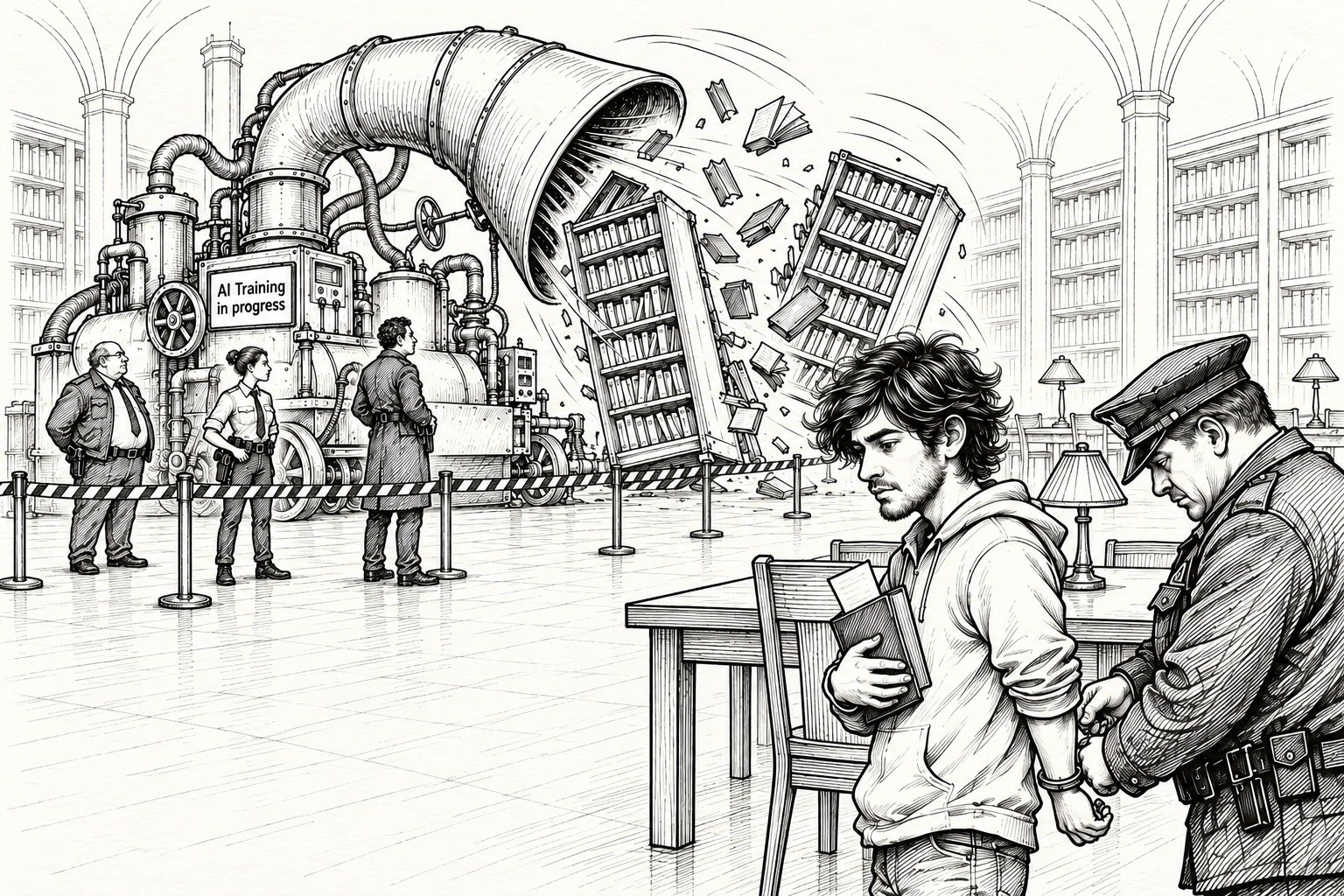
Note that all these companies used these materials to build commercial products. I know that Anthropic has already reached a settlement in this case, but for Meta and OpenAI I found no information about any resolution.
This example of the companies developing AI is especially painful when set against cases like Swartz’s.
And that’s not all: in the pursuit of profit and cost cutting, practically all the remaining corporations that use these very Artificial Intelligences (trained on stolen books) will lay people off and strip them of any sense that what they do has worth!
What then? Are we going to lose our shit and burn those motherfuckers?
Probably depends on how fast it happens: if it’s slow enough, we’ll let ourselves be boiled like frogs.
Remove the Incentives
How do you even fix this? I have no idea, I’m too dumb for it. I know that corporations are something that can strip people of dignity and act downright dehumanizing, but on the other hand I still believe that people organizing themselves into organizations whose operation is modeled entirely differently from the actions of individuals is inevitable. The effect is too powerful for us not to do it.
Looking at today’s companies, at how they come into being and how the whole enshittification of their products and services unfolds, I feel like arguing that corporations shouldn’t depend on providers of capital. You know, what I mean is that there’s a difference between a business that slowly wins its market (organically) and a company that a Venture Capital investor buys intoVenture capital (VC) firms raise money from investors and fund startups in exchange for equity (shares), hoping to sell them later at a big profit. The pressure for that profit can lead to “enshittification,” i.e. the worsening of services: a startup first attracts people with a cheap and good product, locks customers into its ecosystem, and once it’s hard for them to leave — raises prices, adds ads and limits free features. .
But then I remember how in 2013 I launched a business that required buying a few machines — my brother and I had to invest $50,000 just to get it off the ground: so even in such a fairly small case, with an average American wallet in your pocket, you won’t get started without a “provider of capital.”
But wait, we used a bank loan: maybe that means aggressive investors aren’t needed after all? Maybe it’s enough to rely on banks aloneRight, almost forgot: I hate banks even more than corporations! Damn it! , which don’t meddle in operational matters and secure their investments with financial instruments rather than by butting the hell into decisions about how to run the company?
I doubt that solves the main problem, for one reason: you see, if the only internal imperative is maximizing profit for shareholders, then the corporation is practically forced to find ways of pushing every cost onto someone else!
On the principle of: privatize the profits, socialize the losses.
So we ought to take aim at other mechanisms: for example the accountability of those who run them. How the fuck is it that, knowing a specific human being runs the corporation, we agree not to hold him to account when the company goes under?
How is it even possible that we let governments bail out companies, covering up this foul practice with the explanation that the rescued corporations are “too big to fail”?
And so we arrive at the conclusion that part of the problem of socialized losses is simply the result of breaks, guarantees and preferences won by plain, gangster lobbying. In other words, we’re watching big money buy off politicians at every level to gain and keep impunity.
Ah, I was supposed to be pissed off at corporations, and once again I ended up pissed off at the government and corrupt politicians!
Screw this writing thing!