I Was Not a Programmer, After All
· This piece is also available in Polish
When they came for the translators, I did not protest.
I was not a translator, after all.When they came for the graphic designers, I did not protest.
I was not a graphic designer, after all.When they came for the programmers, I did not protest.
I was not a programmer, after all.When they came for the mathematicians, I did not protest.
I was not a mathematician, after all.When they came for me, no one protested.
There was no one leftBased on Martin Niemöller’s original piece from 1946. .
My teenage son had a class at school where they talked about which “old” professions are making a comeback (or could), and which are fading into oblivion.
You know, the world is changing, and schools have to prepare kids — especially teenagers — for those changes. Never mind that, in my opinion, schools are failing at this.
So, the jobs that made the “could make a comeback” list included shoemaker and seamstress. Interestingly, these are trades that the industrial revolution once decimated — and now they’re supposedly getting a second wind thanks to another revolution.
After all, you probably realize that over just the last few years a huge wave of change has been rolling over us: a wave driven by a new technology we call Artificial Intelligence. And anyone who’s given it even a moment’s thought probably isn’t surprised that certain professions are going the way of the dodo, because trends, needs and technological capabilities change. In short: we’re in the middle of Industrial Revolution 2.0.
So yes, coachmenFunny thing, by the way: there’s a myth floating around the internet that in 1894 The Times of London predicted that within 50 years the city’s streets would be buried under 9 feet of horse manure. Unfortunately, as appealing as that forecast sounds, no one has ever managed to confirm that it was actually printed. eventually disappeared — but then taxi drivers came along.
Heck, I don’t know if you knew this, but “human computer” used to be an actual job!
The job was done mostly by women with a background in math or science, and the work involved, for exampleThey also calculated projectile trajectories, drew up firing tables, and prepared tables of the predicted positions of celestial bodies, which sailors used to work out where their ships were. :
- reading measurements off photographs of the instruments during an experiment (e.g., the heights of the liquid columns in manometers) and recording them on worksheets
- painstakingly crunching all the numbers needed for the analysis
- plotting the results on graph paper
- and finally, after double-checking everything, handing the calculations and graphs over to the engineers, who planned the next tests.
It seems to me that translators were one of the first professions to take a real beating, even before AI took off: computers could already translate quite a lot 10 years ago, but the last 2–3 years have sped things up so much that a lot of people simply lost their jobs.
Next came the programmers.
Programmers are an interesting bunch in general, because they’re the ones who built this revolution — literally!
You’d think: surely they knew what they were doing, right? Some of them probably did. But it turns out that really — only a handful did.
Take a look at the chart, which I cobbled together from threads I’ve picked out over time on one industry forum. Notice how the perceived threat changes, and how the “AI is bad at programming” narrative keeps cropping up the whole time, right up to today.
Who is the threat to, according to the discussions?
Rust shows how far the threat has bitten through: from the most distant layer at the top down to “me” at the bottom.
The story stays the same throughout: “AI is bad at programming”, but its conclusion takes on an ever darker tone.
Source: summaries of selected Hacker News threads, 2024–2026. Dots on the chart are selected threads (click to open the discussion).
And now it’s the mathematicians’ turn. Less than two weeks ago, OpenAI dropped a bomb in the form of proofs of solutions to hundreds of math problems on the math community. Plenty of people were shocked; plenty are celebrating.
The problem is that in the industrial revolution, the machines that took over the tasks of the workers of the day reduced physical effort: people could still design, discover, decide and sometimes even invent new occupations.
Now look at today’s trend: if AI is taking over mental abilities too, the promise that “you’ll all move on to more demanding work” completely falls apart! I mean, where is that next rung you can escape to?
Math (the queen of the sciences!) seems like an especially jarring example: after all, it represents the pinnacle of abstract intellectual work.
I mostly follow discussions in the tech industry, and I have to admit they’re not pleasant to listen to: on the one hand, programmers themselves react with horror; on the other, you hear: “we had to adapt, so why do you expect special treatment?” There’s a kind of spiteful satisfaction in it as yet another group loses its sense of being special.
You’re probably thinking: “Nah, that’ll never happen to me,” huh? Wrong!
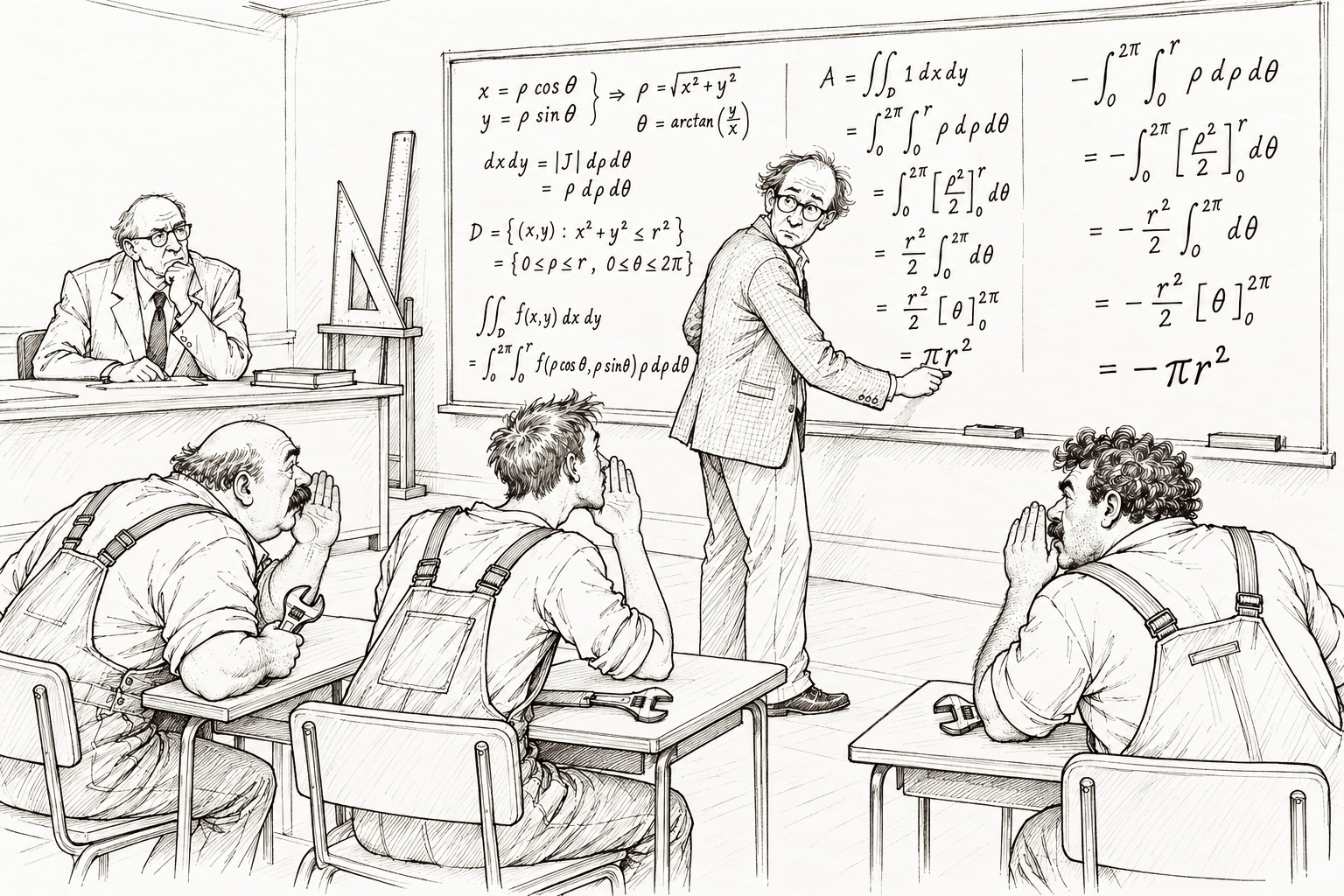
This story doesn’t end with the mathematicians; if you think manual trades (plumbing, construction) are safe, imagine what happens to your paycheck when all those mathematicians and programmers come flooding in looking for workJoke from Poland: A mathematician’s radiator broke. He called a plumber, who banged on it with a wrench, turned something, and the water stopped leaking. The mathematician’s joy was short-lived, though, once the tradesman named his price.
– But mister, that’s half of what I make!
– And where do you work?
– At the university.
– Well then, you come on over to our co-op, mister, you walk around a bit, tap a bit, and you’ll make four times what you make at that whole university thing, mister. You just gotta go to the office, mister, put in an application and that’s that. Just put down you only finished seventh grade, mister, ‘cause higher education don’t pay with us.
The mathematician did as the tradesman had instructed. From then on, life got noticeably better. But one day a directive came down about raising the qualifications of the workforce, and everyone who had only finished seventh grade was sent to night school for eighth grade. First lesson — math. The teacher greets everyone:
– Hello, we’ll be studying math, and I’m sure everyone will get their eighth-grade certificate. But for now let’s go over what we still remember from school. Perhaps you could write down the formula for the area of a circle? – she pointed at the mathematician.
He stood up, went to the blackboard and started deriving it, since he’d happened to forget the formula. He derives and derives, he’s filled the whole board already, and finally he got the result “minus pi r squared.” He doesn’t like that minus, so he starts over. He wipes the board, fills it up with formulas again, and again the result has a minus.
Defeated, he looks at the class hoping for a hint, and they all whisper:
– Swap the limits of integration…
!
I don’t know what the future will bring. What I do see, though, is that the voices expressing fear are getting louder and louder.
And I guess that worries me more than the technology itself.