Who's Afraid of AI in 2026: A View from Poland
· This piece is also available in Polish
I need to get this off my chest, because the subject is starting to get on my nerves.
The two leading companies building AI (Anthropic and OpenAI) have lately been trying, in a somehow weirdly similar way, to spell out the threats their products might bring.
👉 Think for a moment about what you just read
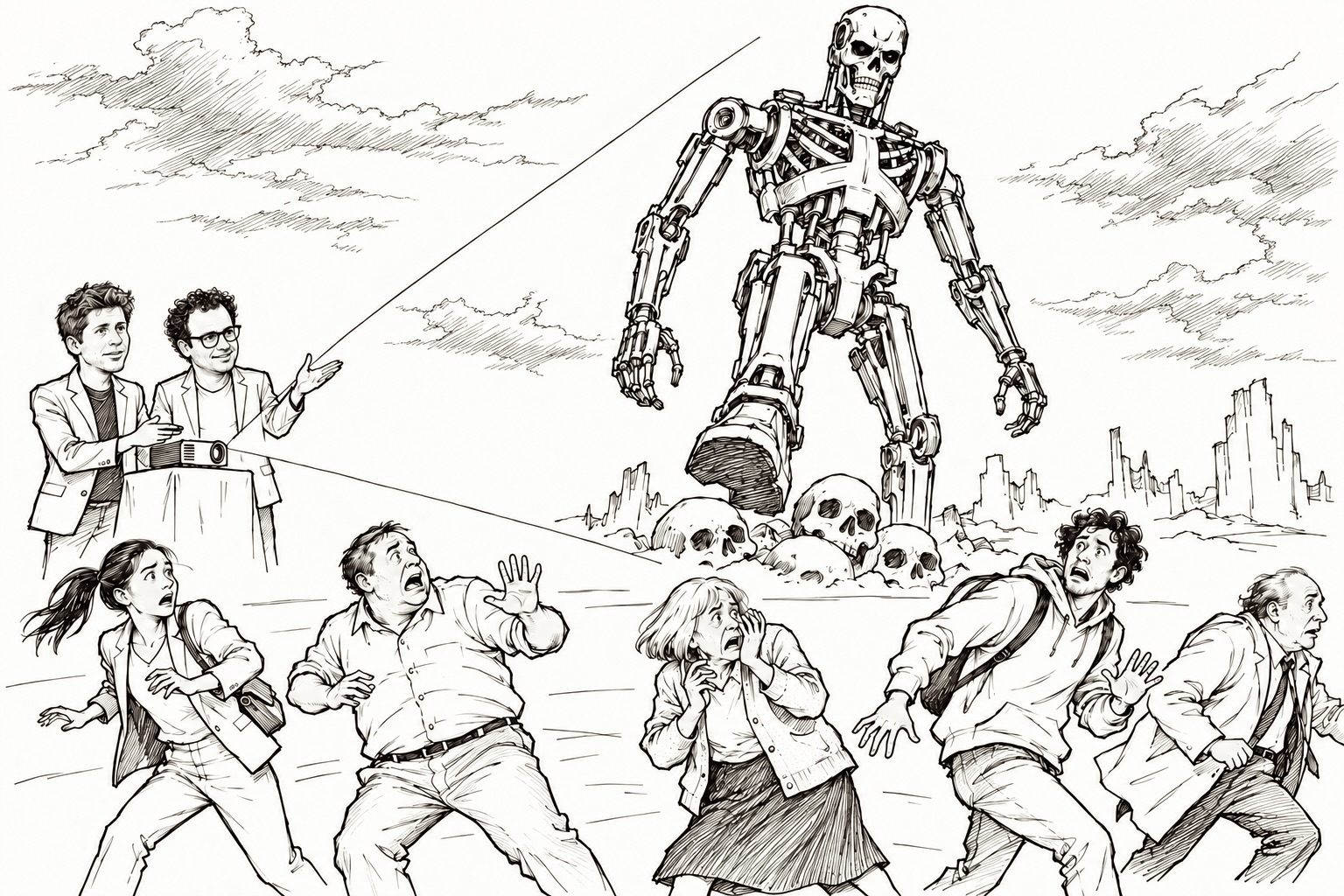
We’re talking about companies that, while making a product, try at all costs to stress how exceptionally dangerous it is in the wrong hands. Can you think of an industry that works exactly like that? That’s right: arms dealers.
Of course, neither of these companies, if asked whether it supplies weapons, would even take the person asking seriously. In fact, I’ll bet that neither you nor anyone you know would even think of these companies in those terms, right?
By their fruits ye shall know them
So let’s look at the facts:
- In mid-2025 both Anthropic and OpenAI were all love and respect with the Pentagon: their relationship blossomed, and the fruit of that blossoming was cooperation agreements 1 and 2 capped at $200 million each. There were more deals of this kind later, by the way, some of them classified
- Anthropic stipulated that it would not agree to supply its technology for fully autonomous weapons; they argued that their models are too unreliable for that purpose (and rightly so). They weren’t too keen either on cooperating when it came to LLM modelsLarge Language Models — a type of artificial intelligence (built on a neural network) trained on huge collections of text for natural language processing tasks, in particular generating text. LLM models can generate, summarize, translate and analyze text in many different contexts. They are what ChatGPT, Claude, Gemini, Grok and DeepSeek run on.
pulling together scattered information about American citizens
- The Pentagon, in turn, demanded “full cooperation” in every case that is consistent with the lawNote that with a technology developing at such lightning speed, the law doesn’t stand a chance of keeping up with the changes: and in scenarios like this it really ought to get ahead of them/anticipate them, because, after all, human life hangs in the balance
- Open conflict broke out on February 27, 2026: His Highness Trump ordered all federal agencies to stop using Anthropic’s technology; Pete Hegseth (US Secretary of Defense) additionally labeled Anthropic a “supply chain risk,” which extended the ban to military contractors. Both sides went to courtBoth sides scored partial victories: on August 27, 2026 a California court, siding with Anthropic, found among other things a violation of free speech and that the Pentagon had acted unlawfully, while on September 25, 2026 the appeals court in Washington, by a 2–1 majority, dismissed Anthropic’s challenge to Claude’s exclusion from the military supply chain.
- Interestingly, in June the Trump administration restricted non-Americans’ access to the (then) most powerful AI models, which meant that Anthropic had to switch those models off for all users for a while, because they weren’t ready to tell who was who.
But that’s only a small slice of the picture: note that Anthropic itself drew up its Responsible Scaling Policy back in 2023, and in May 2025, on the occasion of the Opus 4 launch, they applied additional safeguards for the first time, meant to protect against the risk of misuse (in particular) in the context of chemical, biological, radiological and nuclear weapons (they said it might be more caution than needed, but better safe than sorry).
In April 2026 (in the middle of that whole mess with the US Administration) they decided they wouldn’t let everyone use a model called Mythos: they justified this by its ability to find and exploit software bugs. Instead, they granted access to selected organizations under Project Glasswing.
The slick operators at OpenAI started using the “too dangerous for you to have” narrative even earlier: back in the dim and distant past (by AI-development standards), that is, in 2019, they claimed ChatGPT 2 was so scary that, despite still being a non-profit at the time, they would keep all the details about it to themselves. That, of course, didn’t stop them from selling access to that version and the ones after it (just a reminder: today we’re on version 6.1).
If you think about it, seeing things this way explains a lot when it comes to the race between America and China: each side clearly wants to be first to achieve total technological dominance, but I get the feeling they themselves don’t know what reaching that goal would actually look like.
What, do they think that once Chinese AI reaches the status of the mythical Super-Intelligence, developing on its own in ways beyond the reach of human understanding, everyone will suddenly become subjects of the Chinese Communist Party?
Absurd. But it makes you wonder.
Voices from the industry
I like listening to what people in the industry have to say. And from what reaches me, they tend to take the stories about the AI threat rather skeptically. What they say goes more or less like this:
- old trick: clubs use velvet ropes so that getting in seems more attractive
- they’re probably running a marketing campaign ahead of the upcoming IPO
- they’re limiting it because they didn’t add hardware in time, and user growth meant they ran out of compute
- fear is a sales tool, because a product that’s too dangerous must be powerful!
That’s why, when the Trump Administration blocked Anhtropic’s most powerful models, more than one commenter (myself included) felt a kind of schadenfreudeA German term for the pleasure taken in someone else’s misfortune or failure. : they built up hype about the danger and now they’re surprised someone believed them?
I think the turning point (at least in the industry) was when the news broke about the incident in which OpenAI’s artificial intelligence “agents,” running in a poorly secured research environment, broke into HuggingFace’s servers.
People started commenting that it might be:
- a put-up job aimed at regulationWhy would they want regulation? Well, to shake off the competing AIs from China breathing down their necks, which are usually released under an “open weights” model: meaning you can download them to your own drives and run them on your own machines — provided, of course, you have hardware powerful enough for the job :) of AI companies, or at boosting the share price in the upcoming offering
- total technical incompetence on the part of the people building AI
- a real threat, today mainly in the area of cyber-security (but that’s a minority view)
Remarks charged with anger and impatience also started to ring out pretty clearly, along the lines of “if it’s that dangerous, stop building it!”
And indeed: every now and then a lone individual quits, now Anthropic, now OpenAI; only, as they say, one swallow does not a summer make.
What do the experts say?
But think about it — there are experts in the field of AI, after all, so maybe it’s worth asking: what do they say?
I’ll tell you, I was surprised myself when I looked at the breakdown of what they say: out of the 50 most-cited AI researchers, I decided to throw out the statements of 31: 28 work at companies that develop AI models commercially, and the remaining 3 are either dead or publicly silent.
Of those 19 experts, only two speak in a clearly warning tone about AI: 4 reject AI as a threat to humanity altogether, and 13 speak publicly in a way that’s either mixed or unclear.
Of those four, one particularly cracked me up — Yann LeCun says it plainly: I have no worries whatsoever that AI will destroy humanity, and Dario AmodeiCEO of Anthropic is delusional and simply crazy. xD
I figured that if you took into account those who, because of who employs them, have an interest in building some narrative, their statements would change. And you know what? They didn’t! Among researchers working at companies that build AI — just like among those with no interest in building any particular narrative — only about 10% warn of the threat.
What do people make of it?
Of course, I should point out that listening to the voices of Poles is a different thing from listening to the voices of Americans.
AI ads in the New York subway
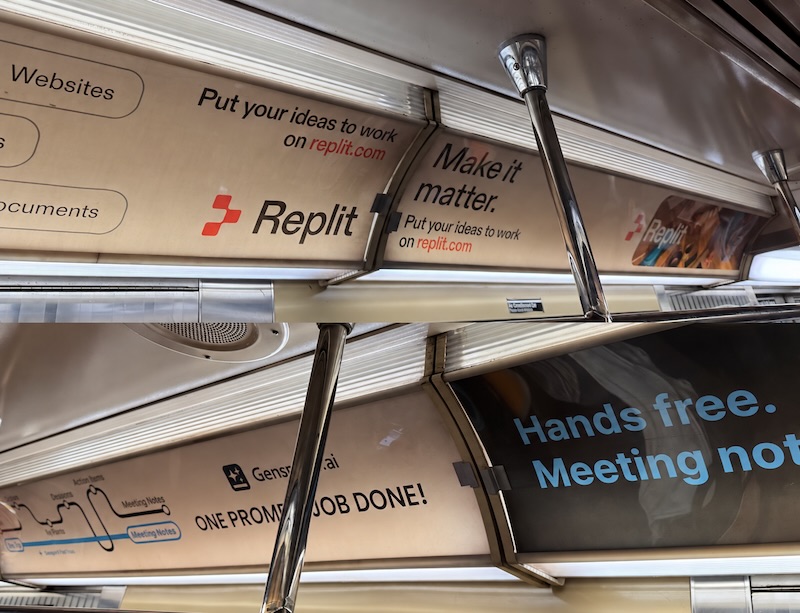
First, the US is where AI was born, and when I was visiting San Francisco and NYC in May/June this year, I saw a whole lot of messaging on the subject in the public space of the big cities: New York subway cars can be dominated by ads for AI-based products, and TV commercials try to convince you that Artificial Intelligence is worth trusting even on medical matters: something that in Poland is pretty much beyond the line of social acceptanceBut I suspect this comes down to differences in the scope and, above all, the cost of healthcare: in Poland we have basic healthcare that’s free for almost all citizens, while in the US there’s a serious problem with that. .
Don’t get me wrong — people consult AI about their health problems — it’s just that in Poland there’s nothing like the aggressive offering and advertising of these kinds of services you see in the States.
So when I listen in on what people in various circles are saying, I hear that:
- it’s just a tool for generating text and funny memes: you’re all getting way too excited
- AI gives lots of new possibilities to people who are idiots, so it can do harm too
- it could lead to annihilation by destroying the environment, because it wastes an awful lot of water (a candidate for a programming job)
- young people generate pictures and videos for hating on their peers, so AI helps hurt children (a teacher at a village elementary school)
- AI will take all our jobs! (lots of voices, so far mostly among programmers, whom I talk to professionally every day)
So I asked myself: who among ordinary people is really scared of AI in 2026? Turns out I’m not the first.
It all depends on how you ask
In September 2026, pollsters in six countries asked people about the threat from AI at almost the same time. Except each of them asked a different question, so you can’t just put the results side by side and compare them.
What they do show, very clearly, is how much the question itself shapes the answer. Ask a Pole straight out: “Does AI pose a threat to humanity — yes or no?” and 58.5% will say yes. Give a Brit a list of possible causes of human extinction and ask them to pick the three most likely: 34% will pick AI, and 58% nuclear war. Does that mean Brits are less afraid of AI than Poles? Not necessarily. They just got a different question.All six surveys were conducted online between September 10 and 30, 2026, with samples ranging from 800 people (Poland) to over 2,000.
Six countries, six different questions
The less you earn, the more afraid you are
Let’s take a closer look at Poland. Among people who take home up to 3,000 złoty a month, 69% see AI as a threat. Among those earning over 7,000 złoty — 56%. And a calm “no, AI is not a threat” comes up more than twice as often in that second group: 35% vs. 15%.For scale: a full-time minimum-wage job in Poland pays about 3,600 złoty a month after taxes in 2026, so the lowest group earns less than that, and 7,000 złoty is roughly twice the minimum wage.
“Do you think artificial intelligence poses a threat to humanity?”
Show table
Interestingly, in Poland fear of AI doesn’t depend on age. 52% of people under 25 see a threat, 65% of 25–34-year-olds, 59% of 35–49-year-olds and 57% of those over fifty — no clear direction at all. In the U.S. and in Germany it’s different: there, older people are clearly more afraid for humanity’s future. In Germany, 65% of people over sixty fear an existential threat, compared with 48% of people in their thirties.SW Research for Rzeczpospolita, one of Poland’s major daily newspapers, September 29–30, 2026, 800 internet users aged 18 and over, weighted to match the makeup of Polish adults. The pollster didn’t publish how many people are in each group. With groups of around 100–150 people, a result can swing by 8–10 points by pure chance, so I only write about differences that are large or that show up in other countries too.
September, or suddenly everyone’s reading about it
In early September, the dangers of AI suddenly hit the front pages. You can see it just by looking at the English Wikipedia article on existential risk from AI: in August it got about 21,000 views, and in September almost 120,000. That’s nearly six times more than a month earlier, and more than three times the peak of the previous such wave, in spring 2023.
The number of views doesn’t tell you what people think about AI — only that the topic suddenly got everyone’s attention. But all the September polls I mentioned above (the Polish one included) were done right in the middle of that wave.
Did it push the results up for good? Further polls will probably tell. After the jump in 2023, the share of Americans afraid that AI will bring about the end of humanity fell from 46% to 36% over 20 months. But then it started climbing again, and before September’s record, too: in July 2026 it was 47%, and in September 50%. In the UK, the 2023 increase has held almost entirely, and the same question that got 34% in September got 15% a year earlier.YouGov US, “How concerned, if at all, are you about the possibility that AI will cause the end of the human race on Earth?”, “very” and “somewhat” combined: April 2023 — 46%, December 2024 — 36%, July 2026 — 47%, September 2026 — 50%. YouGov UK, “Which of the following do you think are most likely to cause human extinction? (up to three)”, robots/AI: 7% in February 2022, 17% in May 2023, 15% in August 2025, 34% in September 2026.
How many people read the Wikipedia article on existential risk from AI each monthWikimedia, views of the article “Existential risk from artificial intelligence” on English Wikipedia, including its former title.
Show table
In everyday life: Poland among the most worried
So as not to rely on September alone, let’s look at a survey that’s repeated every year. Pew Research Center asks the same thing in dozens of countries: does the increased use of AI in daily life make you more concerned or more excited? Note that this is not a question about the end of humanity, just about ordinary, everyday attitudes toward AI.
Between spring 2025 and spring 2026, the share of people whose concerns outweigh their excitement rose in 19 of 25 countries. In Poland, from 37% to 45% — only Sweden saw a faster rise. In the U.S., worry was already high and grew only slightly: from 50% to 52%.
More concerned than excited: spring 2025 → spring 2026Pew Research Center, Global Attitudes Survey, January–April 2025 and February–May 2026, about 1,000 people per country; in the U.S., Pew’s own panel, June 2025 and June 2026. The question: “Overall, how would you say the increased use of artificial intelligence in daily life makes you feel?” Changes of 1–3 points are within the range of random fluctuation.
Show table
Across the whole survey, 37 countries in all, there’s a simple pattern: the most worry is in English-speaking countries, in Europe and in Latin America, the least in Asia and Africa. Australia leads (53%), followed by the U.S. and Brazil (52% each), and Poland is seventh out of 37 countries. At the other end are India (20%), Israel (19%) and Sri Lanka (8%).Pew Research Center, spring 2026, 37 countries, about 1,000 people each, by phone, in person or online depending on the country. Poland ties (45%) with the West Bank and East Jerusalem.
Stop superintelligence?
In spring 2026, an online survey in 104 countries asked what should be done about developing superintelligence, meaning AI that outperforms humans at everything. 37% of Poles and 39% of Americans want to stop it for good or pause it until someone proves it’s safe — about the world average. Support for hitting the brakes is highest in Vietnam (51%), India (45%) and many African countries, and lowest in Japan (19%) and Taiwan (21%).
Share of people who want to stop or pause the development of superintelligence, spring 2026
Show all countries and answers
Nira Data, Spring 2026 World Omnibus, March 19 – April 21, 2026, 104 countries, 377,000 people (2,839 in Poland, 5,062 in the U.S.). It’s an online survey people find through ads, with no random sampling. Results were adjusted to match age, gender and education, but that doesn’t remove the differences between respondents and the rest of society: in countries where only a minority uses the internet, the results describe urban internet users rather than the whole country. The question: “Some companies are working on developing superintelligent AI (artificial intelligence) that can outperform humans in all tasks. Which comes closest to your view?” The map shows “Stop development permanently” and “Pause development until it is proven safe” combined; the other answers were “Continue development with strict oversight,” “Continue development as quickly as possible” and “Not sure.” Values read off the charts on the survey’s website.
Others will lose their jobs, not me
Remember the voices saying AI will take all our jobs? 46% of Poles and 55% of Americans think AI will make the job market in their country worse. But only 20% of Poles and 25% of Americans expect AI to replace their own job within five years. In other words: others will lose their jobs, not me. In China it’s exactly the opposite: 25% fear for the job market, and 52% for their own job.Ipsos AI Monitor 2026, March 20 – April 3, 2026, 32 countries, 500–1,000 people each, online. Questions: “Will the increased use of AI make the following better, worse or stay the same in the next 3-5 years? The job market,” and how likely it is that AI will replace your current job in the next five years.
The job market vs. my job
Show table
So far, according to the poll, 2.2% of Polish adults have lost a job or some of their work because of AI.CBOS, a Polish public opinion research center founded in 1982, May 2026, random sample of 1,041 Polish adults. The answer: “I have lost my job or have fewer contracts because of the introduction of artificial intelligence.”
The Chinese: brakes or pedal to the metal
Finally, China — the other country, besides America, where leading AI models are built. On the superintelligence map, China looks calm: 32% of Chinese want to stop or pause its development, fewer than Poles (37%) and Americans (39%). But that number hides a split. 23% of Chinese want development stopped permanently — as many as Americans (22%) and a bit more than Poles (20%). And at the same time, 25% want superintelligence developed as fast as possible — almost twice as many as in the U.S. (13%).
Stop permanently or develop as fast as possible? China, the U.S. and Poland, spring 2026The same Nira Data survey as the map above. The other answers: “Pause development until it is proven safe” — China 9%, U.S. 17%, Poland 17%; “Continue development with strict oversight” — 27%, 19%, 23%; “Not sure” — 15%, 28%, 21%. In China, online surveys are filled out mostly by city dwellers who are better educated and better off than the average Chinese person.
Show table
Sources
- SW Research for Rzeczpospolita, September 2026 (in Polish)
- Pew Research Center, global survey on AI, 2026 (report)
- Pew Research Center, global survey on AI, 2025 (report)
- Pew Research Center, The gender gap in AI, 2026
- INSA for IDEA, September 2026 (in German)
- Research Co., Canada, September 2026 (tables)
- YouGov UK, September 2026 (tables)
- YouGov UK, AI as a cause of human extinction, series since 2016
- YouGov US, April 2023
- YouGov US, September 2026
- POLITICO / Public First, September 2026 (The Hill)
- POLITICO / Public First, France (Clubic, in French)
- Ipsos AI Monitor 2026 (report)
- CBOS, report 59/2026 (in Polish)
- Nira Data, Global attitudes towards the development of superintelligent AI, spring 2026
- Wikimedia pageview statistics
Instead of a conclusion
Let me put it this way: it turns out I live in a bubble. I was convinced that hardly anyone took the idea of AI as an existential threat to humanity seriously. And yet, as you can see for yourself, there are actually plenty of such people today!
Sure, there are plenty of indications that the frightened ones simply swallowed the narrative of those who have a stake in the scaring.
But maybe I’m the naive one?
I believe that AI will 100% change humanity: it’s already flipped a lot of tables, and I’m sure it’ll flip more.
I can also see that the leading corporations developing AI are doing it in a way typical of Silicon Valley culture — anything to get ahead of the competition, and anything to get as rich as possible along the way. This omnipresent greed and lack of respect for the little people is downright repulsive to me, disgusting.
And maybe it’s these very corporations that are the biggest threat (or even the psychopaths at their helm) — but when I look at how people use the current models, I have a hunch that, one baby step at a time, we’ll simply stop trying. We’ll stop exerting our brain cells — we’ll get dumber, in other words. We’ll regress in our intellectual abilities, and at the first crisis that comes along we’ll die a miserable death.
But you know what? If that happens, then good — because then it’ll be emphatic proof that, as the human race, we deserved to be eliminated.
The only control or “guardrails” that AI needs is a STRONG AND SMART (High IQ!) PRESIDENT, and the U.S.A. has that, in spades! The Trump Administration has stopped AI “people” from doing bad, or potentially bad, “things,“ like Dario (Anthropic!), who is now pretending to be a “perfect little angel” - and we will continue to do so! We already have tremendous CRIMINAL and REGULATORY power over these companies! There is a SICK conspiracy going on against AI and Data Centers, and the only one that is happy about it is China. WHOEVER WINS AI, WINS! We are leading China, and all others, and will continue to do so. Conspiracy Theorists, Treasonists, Traitors, and Leakers, BEWARE! Thank you for your attention to this matter!